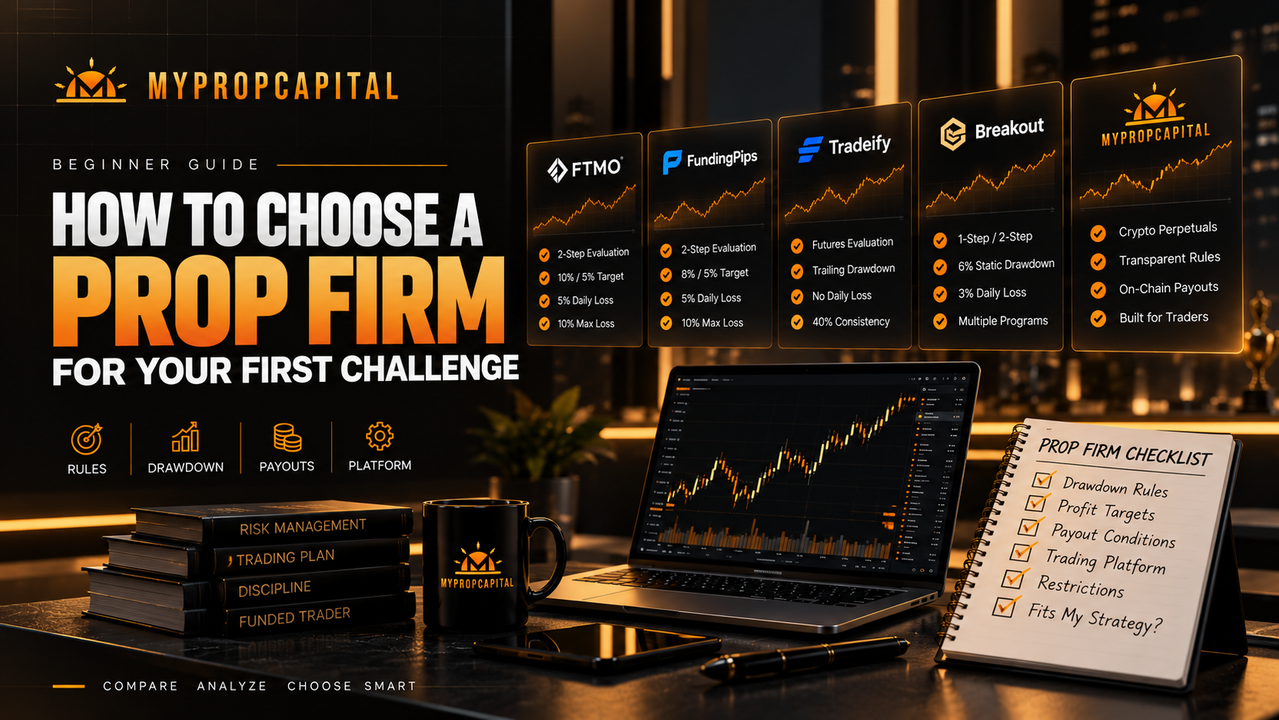
Wondering how to choose a prop firm for your first challenge? The answer isn't simply finding the biggest funded account, highest profit split or cheapest evaluation. A beginner should compare drawdown, daily loss limits, profit targets, payout rules, trading restrictions and the platform before paying for a challenge.
If you're buying your first prop firm challenge, here's the most important thing to understand:
Don't choose a prop firm by account size alone. Choose it by the rules you will actually have to trade.
This guide explains how to do that.
We'll also use firms such as FTMO, FundingPips, Tradeify, Breakout and MyPropCapital (MPC) as real-world examples of how different prop models can be. Before comparing firms, it also helps to see how an actual evaluation is structured. You can explore our pricing page to see how account size, profit targets, daily loss and maximum drawdown work together.
Quick answer: Before choosing a prop firm, compare its maximum drawdown, daily loss limit, profit target, drawdown type, payout conditions, consistency rules, minimum trading days, supported markets and trading platform. Then check whether those rules actually fit your trading strategy.
First: Understand What You're Actually Buying
A prop firm challenge — often called an evaluation — is essentially a test of whether you can reach a profit objective without breaking predefined risk rules.
A typical evaluation may include:
- A profit target
- Maximum daily loss
- Maximum overall drawdown
- Minimum trading days
- Consistency rules
- Position-size limits
- Trading restrictions
- Payout requirements
And this leads to one of the biggest mistakes beginners make.
A $100K account doesn't mean you have $100K to lose.
If a $100,000 challenge has a 6% maximum drawdown, your effective loss budget is $6,000.
That $6,000 matters more to your survival than the "$100K funded account" headline.
This is why we recommend starting your comparison with risk rules, not marketing numbers.
1. Start With Maximum Drawdown
Before checking the challenge price, profit split or even the profit target, find the maximum drawdown.
It tells you how much room you actually have when trades go against you.
But the percentage alone isn't enough.
You also need to know how the drawdown works.
Static Drawdown
A static drawdown stays at a fixed level.
Imagine:
- Account: $100,000
- Maximum loss: 6%
- Loss allowance: $6,000
- Breach level: $94,000
If the rule is genuinely static, that $94,000 floor does not keep moving upward simply because you make profits.
This makes the risk budget relatively easy to understand.
Trailing Drawdown
Trailing drawdown works differently.
The loss threshold can move upward as your account reaches new balance or equity highs, depending on the firm's calculation.
This means two challenges advertising the same account size can behave very differently.
For example, Tradeify's current evaluation accounts use an end-of-day trailing drawdown. The floor updates based on the highest end-of-day balance and is enforced against net liquidation value in real time.
The words "end-of-day" therefore don't mean you can ignore the threshold during the day.
That's exactly why reading the calculation matters.
MPC Tip
Before buying any challenge, you should be able to answer this sentence without guessing:
"My account will fail if ______ happens."
If you can't fill in that blank precisely, read the drawdown rules again.
2. Check the Daily Loss Limit
Maximum overall drawdown and maximum daily loss are two different things.
A firm may give you reasonable overall drawdown but still impose a tight daily limit.
Let's say your challenge has:
$100,000 starting balance
5% daily loss limit
At first glance, you might think:
"Easy. I can lose $5,000 today."
Not necessarily.
You still need to find out:
- Is the limit calculated from balance or equity?
- Does floating P&L count?
- Do commissions and swaps count?
- When does a new trading day begin?
- Does today's profit change tomorrow's limit?
- What happens to trades held through the reset?
These details matter.
FundingPips' current 2-Step Standard, for example, uses a 5% daily loss limit calculated from the higher of the opening balance or opening equity, while its maximum overall loss is a static 10% of the starting account size.
FTMO's current 2-Step also uses a 5% maximum daily loss, but its exact calculation and reset mechanism are defined separately in its trading objectives.
Same headline percentage.
Different rulebook.
Always read the calculation, not just the number.
3. Compare Profit Target Against Drawdown
Beginners naturally focus on the profit target.
That's understandable.
After all, that's the number you have to reach to pass.
But there's a better question:
How much profit am I required to make relative to how much I'm allowed to lose?
Suppose:
Challenge A
- Profit target: 10%
- Maximum drawdown: 10%
Challenge B
- Profit target: 10%
- Maximum drawdown: 5%
Both ask you to make 10%.
But they don't give you the same risk budget.
This is one reason comparing challenges purely by price can be misleading.
A useful mental model is:
Profit Target ÷ Maximum Drawdown
It isn't a perfect measure — daily limits and other rules still matter — but it forces you to think about the challenge as a risk problem instead of a prize.
Breakout makes a similar point in its own educational material: traders should size positions around their available drawdown budget rather than obsessing over the profit target.
That's a much healthier way to approach an evaluation.
4. Static vs Trailing Drawdown Can Change Everything
This deserves repeating because beginners regularly underestimate it.
Imagine you make a strong profit early in your challenge.
With a static drawdown, your original loss floor may remain unchanged.
With a trailing model, the drawdown floor may move upward as the account grows.
Neither system automatically makes a prop firm good or bad.
They simply require different risk management.
A trader comfortable with one model may hate the other.
So when you're comparing firms, don't write:
Max drawdown: 6%
Write:
Max drawdown: 6% — STATIC
or:
Max drawdown: $X — EOD TRAILING
That one extra word can completely change your understanding of the challenge.
5. Look for Minimum Trading Days and Consistency Rules
Imagine you hit the required profit target in two excellent trading sessions.
Are you done?
Maybe.
Maybe not.
Some evaluations require minimum trading days.
Others include consistency requirements.
For example, FTMO's current 2-Step evaluation requires at least four trading days in both the Challenge and Verification stages.
FundingPips' current 2-Step Standard requires at least three trading days per phase.
Tradeify's current Select evaluation has a 40% consistency requirement, meaning one trading day cannot account for more than 40% of the required total profit when qualifying.
This matters particularly for traders whose strategy produces occasional large winning days.
Before buying, check:
- Minimum trading days
- Maximum trading days
- Consistency percentage
- Best-day rules
- Minimum profitable days
Don't assume hitting the profit target automatically means passing.
6. Check Whether There Is a Time Limit
Time pressure changes trader behaviour.
A strategy that normally produces five good setups per month doesn't magically produce twenty because your prop challenge expires soon.
That's when traders begin forcing entries.
If a challenge has a deadline, ask yourself:
Can my normal strategy realistically reach the target within this period?
If the answer is no, you're buying a challenge that encourages you to stop trading your normal strategy.
Unlimited-time evaluations remove one source of pressure, but they don't automatically make a program easier. You still have to satisfy every other rule.
The important part is compatibility.
7. Read the Payout Rules Before You Pay
A surprising number of traders research how to pass a challenge without researching how they eventually get paid.
Don't make that mistake.
Before purchasing, find answers to:
- When is the first payout available?
- How frequently can payouts be requested?
- What is the profit split?
- Is there a payout cap?
- Is a minimum balance required?
- Is there a consistency rule for payouts?
- Are there profitable-day requirements?
- Does requesting a payout affect drawdown?
- What KYC requirements apply?
The advertised profit split alone doesn't answer these questions.
A firm advertising 90% may have different withdrawal conditions from another firm advertising 80%.
You need the complete structure.
8. Don't Compare Forex, Futures and Crypto Prop Firms as if They're Identical
This is another important beginner mistake.
The prop industry now contains different types of firms.
You may be comparing:
- Forex/CFD evaluations
- Futures evaluations
- Crypto/perpetual evaluations
But these are not interchangeable products.
For example:
FTMO and FundingPips operate evaluation models associated primarily with the forex/CFD prop space.
Tradeify focuses on futures.
Breakout is built around crypto trading.
MyPropCapital (MPC) is designed around crypto perpetual trading.
The right question therefore isn't:
"Which prop firm has the biggest account?"
It is:
"Which prop firm gives me access to the market I actually know how to trade?"
If you've spent years trading forex, don't choose a futures evaluation just because you saw a discount.
If your edge is in crypto perpetuals, compare crypto-native offerings and their rules.
Your strategy should determine the product.
Not the advertisement.
9. Check the Trading Platform Before Buying
You may love the challenge rules and hate the platform.
That's still a bad combination.
Check:
- Available trading platforms
- Order types
- Charting
- Execution environment
- Available instruments
- Trading hours
- Mobile access
- Commissions
- Spreads or fees
- Maximum position sizes
Ideally, use a demo or free trial if one is available.
A trader shouldn't discover the platform for the first time after paying for the challenge.
10. Research the Firm Outside Its Own Website
This might be the most underrated step in this guide.
Every prop firm's own website is naturally going to present its product positively.
That includes us.
So don't stop there.
Do independent research.
One useful starting point is Prop Firm Match, which allows traders to compare firms across areas such as fees, drawdown rules, platforms, reviews and payout information.
Its payout tracker also publishes firm-level payout data including payout counts, amounts and median processing times.
That doesn't mean you should blindly trust a ranking or review website either.
Use it as another data point.
A sensible research process looks something like this:
Step 1 — Read the prop firm's official rules.
Step 2 — Compare those rules independently.
Step 3 — Check payout information.
Step 4 — Read trader feedback — including negative feedback.
Step 5 — Return to the official terms and verify anything important before paying.
For country-specific eligibility, check this too.
A challenge is useless if your country isn't supported.
Prop Firm Match, for example, maintains country-specific availability pages alongside its general comparison tools.
The point isn't to find someone online who tells you:
"This is the best prop firm."
The point is to collect enough information to decide whether the rules suit you.
11. Five Popular Prop-Firm Models Show Why Comparison Matters
Instead of trying to rank firms from best to worst, let's look at several current examples.
Their differences demonstrate why there isn't one set of rules across the industry.
FTMO
FTMO offers both 1-Step and 2-Step evaluation structures.
Its current 2-Step model uses:
- 10% Phase 1 profit target
- 5% Verification target
- 5% maximum daily loss
- 10% maximum loss
- 4 minimum trading days per phase
Its current 2-Step maximum loss is static.
FTMO's 1-Step works differently and includes its own daily loss, maximum loss and Best Day rules.
That's an important lesson by itself:
Don't just research a company. Research the exact challenge you're buying.
FundingPips
FundingPips also offers multiple evaluation models.
Its current 2-Step Standard includes:
- 8% Phase 1 target
- 5% Phase 2 target
- 5% daily loss
- 10% maximum overall loss
- 3 minimum trading days per phase
FundingPips also offers different reward-cycle options on its Master stage.
Again, one company's different products can have different rules.
Tradeify
Tradeify is a useful example from the futures side of the industry.
Its current Select evaluation offers several account sizes and uses an end-of-day trailing maximum drawdown.
The Select evaluation currently has no daily loss limit, but it does have a 40% consistency requirement.
After passing, Select traders choose between different payout structures, each carrying its own payout and risk conditions.
That's considerably different from simply buying a forex-style two-phase challenge.
Breakout
Breakout provides another useful comparison because its current program includes multiple crypto evaluation structures.
Its published program rules currently show Classic, Pro and Turbo 1-Step evaluations as well as a 2-Step option.
For example, its Classic 1-Step currently combines:
- 10% upgrade target
- 6% static maximum drawdown
- 3% maximum daily loss
Other Breakout models change those parameters.
Once again:
Firm name alone isn't enough.
You need the exact program.
MyPropCapital (MPC)
MyPropCapital approaches the market from a crypto-native angle.
MPC is built for traders who want to trade crypto perpetual markets rather than trying to force a forex or futures prop model onto their existing crypto strategy.
And that's part of the reason we're writing this guide instead of simply telling you to buy an MPC challenge.
A trader should understand the rules first.
If MPC's markets, drawdown structure, evaluation model and payout system fit the way you trade, then it deserves to be on your shortlist.
If they don't, you should know that before purchasing an evaluation.
That's how prop trading should work.
Before you buy, read the full MPC trading rules and how payouts work. On our 1 Step Classic evaluation the profit target is 10%, the daily loss limit is 2% and the max drawdown is 6%, with no minimum trading days, no time limit and leverage up to 10x per position. Funded traders keep 80% of the profit, paid in USDT on Arbitrum straight to their own wallet.
12. Use a Comparison Sheet Before Buying
Here's a simple way to compare any firms you're considering.
| Factor | Firm A | Firm B | Firm C |
|---|---|---|---|
| Market | |||
| Challenge size | |||
| Challenge fee | |||
| Profit target | |||
| Daily loss | |||
| Maximum drawdown | |||
| Static or trailing? | |||
| Minimum trading days | |||
| Time limit | |||
| Consistency rule | |||
| Profit split | |||
| First payout | |||
| Payout cap | |||
| Platform | |||
| News trading | |||
| Weekend holding | |||
| Country supported | |||
| Rules understood? | Yes / No | Yes / No | Yes / No |
Fill this table using official rules.
Then use independent sources such as Prop Firm Match to cross-check your research.
Suddenly choosing a prop firm becomes much less confusing.
13. Don't Let Discounts Make the Decision
You've probably seen something like:
50% OFF — ENDS TONIGHT
Then another discount appears three days later.
Challenge price matters.
But saving $30 on a challenge whose rules don't suit you isn't saving money.
Look at price after you've compared:
- Drawdown
- Daily loss
- Target
- Payout conditions
- Trading restrictions
- Platform
- Market
Then compare fees.
Not the other way around.
14. Your First Challenge Probably Doesn't Need to Be Huge
There's nothing wrong with starting small.
In fact, your first challenge is partly an opportunity to learn how the firm's system works.
You're learning:
- Dashboard behaviour
- Drawdown calculations
- Daily reset
- Execution
- Platform
- Payout rules
- Compliance rules
A smaller evaluation can let you understand that environment before committing more money to larger challenges.
Passing a $100K challenge isn't automatically more impressive than trading a smaller challenge properly.
The skill you're trying to build is rule-based risk management.
15. The 5-Minute Checklist Before You Buy
Before entering your card details, answer every question below.
Risk
- What is the maximum drawdown?
- Is it static or trailing?
- What is the daily loss limit?
- Does floating P&L count?
- Exactly what causes an account breach?
Evaluation
- What is the profit target?
- How many phases are there?
- Are there minimum trading days?
- Is there a time limit?
- Is there a consistency or best-day rule?
Trading
- Can I trade my normal strategy?
- Are my preferred instruments available?
- Can I trade news?
- Can I hold overnight?
- Can I hold over weekends?
- Are EAs or automated strategies allowed?
Payouts
- When can I request my first payout?
- What percentage do I receive?
- Is there a payout cap?
- Are profitable days required?
- Does taking a payout change my drawdown?
Company
- Can I easily find the official rules?
- Does the firm support my country?
- Are important conditions explained clearly?
- Can I find independent reviews?
- Can I find independent payout information?
If you can't answer most of these questions, you're not ready to buy that challenge yet.
Spend another 20 minutes researching.
It may save you an entire challenge fee.
So, How Should a Beginner Choose a Prop Firm?
Ignore the giant account number for a moment.
Ignore the discount.
Ignore the screenshots on social media.
Start with four things:
1. What do I trade?
Forex? Futures? Crypto?
2. How much drawdown do I actually have?
Not account size. Real loss allowance.
3. Do these rules fit my strategy?
Daily loss, trailing drawdown, consistency, minimum days and trading restrictions.
4. Can I clearly understand how I eventually get paid?
If those four answers make sense, then start comparing price and profit split.
That's a much better way to choose your first prop firm.
Final Thoughts
There isn't one prop firm structure that suits every trader.
FTMO, FundingPips, Tradeify, Breakout and MPC illustrate exactly why.
Different markets.
Different evaluation structures.
Different drawdown models.
Different payout conditions.
The goal shouldn't be to find the prop firm with the loudest marketing.
The goal should be to find a challenge where your existing trading strategy can operate comfortably inside the rules.
At MPC, that's also how we think traders should approach our own challenges.
Understand the risk.
Compare us.
Then decide.
Because a prop firm challenge should test your trading — not your ability to discover hidden rules after you've already paid.
Last reviewed: September 2026. Prop firm rules can change frequently. Always verify current evaluation, payout and trading rules on the firm's official website before purchasing an account.
Risk disclosure: Prop firm evaluations involve financial risk, including the potential loss of evaluation fees. Many prop trading programs operate using simulated trading environments. Passing an evaluation does not guarantee future profitability or payouts. Trading leveraged products can result in substantial losses.