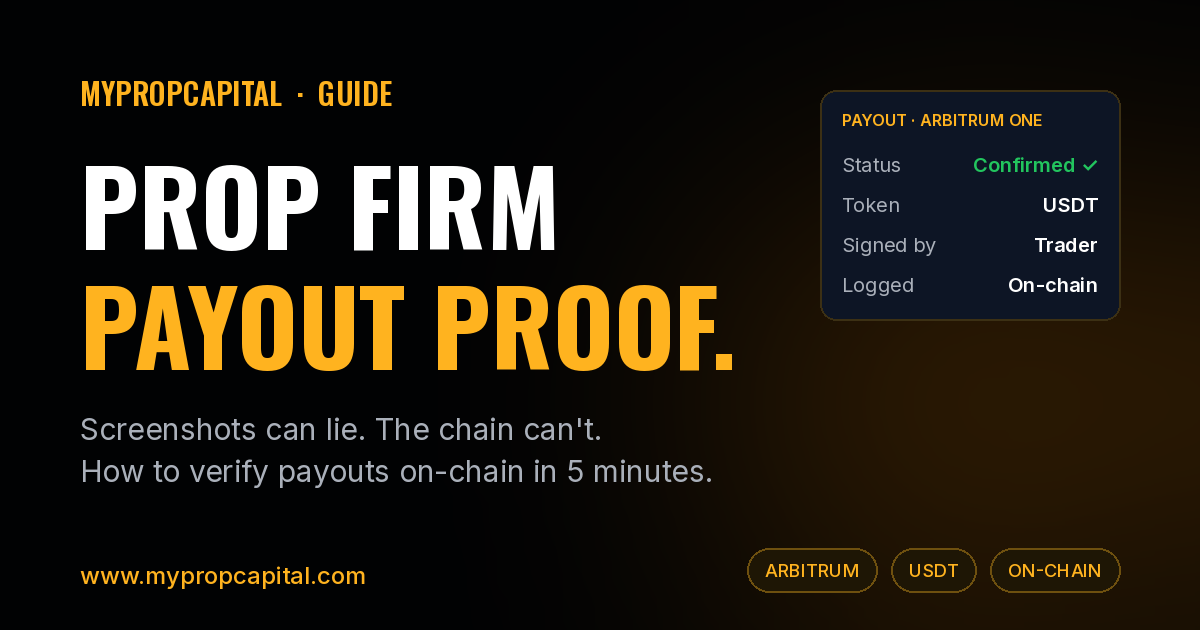
Prop firm payout proof is usually a screenshot: a green "Approved" badge, a big number, a happy trader holding a phone. It looks great on Instagram. As evidence, it's close to useless. Anyone can edit an image, and even a real one proves somebody got paid once. It says nothing about whether you will. This guide shows you what real payout proof looks like, how to check it yourself on-chain in about five minutes, and the red flags that should make you close the tab.
Quick answer: real payout proof is something you can check without trusting the firm. On a public blockchain that means three things. The payouts come from a known contract or wallet. Each payout is tied to an account and the rules it traded under. And you can follow the money backwards, from the payout to where the fees came in.
Why screenshots don't count as payout proof
Traditional prop firms run the whole payout pipeline in private. You trade, you request, a payout team reviews, and money arrives (or doesn't) through a bank, an e-wallet or a payment processor. The firm is the only one who sees the full ledger.
That's where denied payouts come from. The usual reasons are rules traders didn't know they were breaking: consistency rules, minimum trading days, first-payout caps, and vague "prohibited strategy" clauses applied after the fact. The CryptoSlate guide to checking whether a prop firm is legit makes the same point: what matters is the written payout obligation and whether the operation can actually back it, not the marketing.
So when a firm posts "$40M paid to traders," ask the boring question: says who?
- A screenshot can be edited.
- A "payout certificate" is a PDF the firm made itself.
- A testimonial can be written by anyone.
- A total on a dashboard is just a number someone typed.
Payout trackers that watch a firm's "known" payout wallet are a step up, because the transfers are real. But a USDT transfer only proves that money moved. It doesn't prove it was a trader's profit share, paid under published rules, rather than a refund, a team wallet or an affiliate.
What real payout proof looks like
Good proof has five properties. Use this as your checklist:
- Public source. The firm publishes the exact wallet or contract addresses. No addresses, no proof.
- Tied to an account. Each payout points to a specific funded account, not just "a wallet."
- Tied to the rules. The account's rules (profit split, drawdown, target) are recorded when the account opens, so they can't be quietly changed before payday.
- Money in and money out. You can see fees arriving and payouts leaving, so the totals add up.
- Owner moves are visible. If the people running the firm take money out, that shows up too.
A firm that ticks all five has given you something no screenshot can: the ability to stop trusting them and just check.
How to verify prop firm payouts on-chain in 5 minutes
You don't need to code. You need a block explorer. For anything on Arbitrum One, that's Arbiscan.
Step 1: Get the addresses from the firm itself
Look for an "on-chain," "transparency" or "contracts" page. If the firm claims on-chain payouts but won't give you a single address, that tells you everything. Ours are on the transparency page and in the handbook.
Step 2: Open the payout contract and look at what leaves
Paste the payout address into the explorer and open the token transfers tab. Real payouts look like steady USDT transfers out to many different trader wallets. Warning signs: one big transfer out to a single address, round-number transfers to the same handful of wallets, or no activity at all while the firm claims millions paid.
Step 3: Read the events, not just the transfers
Smart contracts emit events, which are a permanent log of what happened and why. A payout event should tell you the account, the trader and the amount. That's what turns "money moved" into "this funded account was paid its profit share."
Step 4: Follow the money backwards
Where does the payout contract get its money? Open the address that funds it. If you can trace fees coming in, money moving into the payout pool, and payouts going out, the firm's numbers can't drift away from reality.
Step 5: Check that the rules can't move
Ask whether each account's rules are written on-chain when the account opens. If they are, the firm can change what it sells tomorrow but can't change the deal you already bought. That's the main defence against retroactive rule changes.
The red flags
- "On-chain payouts" with no addresses published.
- Payout proof that's only images, videos or Discord shout-outs.
- A payout wallet funded from a wallet you can't identify.
- Rules that say the firm can review, delay or deny payouts at its "sole discretion."
- Payout totals on the website that you can't reconcile with anything on the explorer.
How it works at MyPropCapital
We built MyPropCapital so you never have to take our word for any of this. Here's the full money path on Arbitrum One:
| Contract | What it does | Address |
|---|---|---|
| Accounts ledger | Records purchases, every account and its rules hash, every pass, breach and payout | 0x8EddEE86E29a58b59CeA2215E9FDCfC1B4FAfb23 |
| Treasury | Receives every evaluation fee in USDT | 0x8137c6A79f605aC14E04689AC1257d29B3503177 |
| Payout vault | Pays funded traders in USDT, with the profit split and daily limits enforced in code | 0x06c105206Fb9a57e7F278dE53673d1F9aABc116f |
Money in. You pay a one-time evaluation fee in USDT on Arbitrum, from $25 for a $5K 1 Step Light up to $500 for a $50K account. You sign and we cover the gas. The fee lands in the treasury and the purchase is logged on the ledger. Every size and price is on the pricing page.
The sweep. The treasury keeps an operating buffer and sends a share of everything above it to the payout vault through a public sweep(). Anyone can trigger it, and the destination was fixed when the contract was deployed and can never be changed. So whoever presses the button, the money can only go one way.
Owner withdrawals need a reason. If we take funds out of the treasury, the contract refuses unless there's a written reason, and that reason is emitted on-chain. It shows up on our public receipts page, next to every fee, sweep, top-up and payout, each with a link to the transaction.
The rules are frozen. When your account opens, its full rule set is hashed onto the ledger. Pick 1 Step Classic (10% target, 2% daily loss, 6% static max drawdown), 1 Step Float (10% target, no daily limit, 5% static, 2% floating cap) or 1 Step Light (9% target, no daily limit, 3% static), and that's your deal through evaluation and funded. There's no consistency rule and no minimum trading days. The full sheet is on the rules page.
Money out. Funded traders keep 80% of the profit. Close your positions, press Withdraw in the terminal and sign the request in your own wallet. The contract checks your signature, caps the payout at your 80% share of profit above the starting balance, and the vault sends USDT to your wallet. Payouts land in seconds, the same day you ask, with no cooldown before the next one. There's no minimum payout, no withdrawal fee from us, and gas is on us. More on the payouts handbook page.
Your wallet is self-custodial and secured by Privy. We never hold your keys, so nothing moves out of it without your signature.
Want to check us right now?
Open the receipts page and click any line to see the transaction on Arbiscan. Or read the totals straight from the ledger:
``ts const paid = await ledger.totalPaidOut(); const fees = await ledger.totalFeesCollected(); const accounts = await ledger.accountCount(); ``
We're a new firm, so our numbers are small and growing. That's fine. The point is that they're real, and you can watch them change.
What the chain can't tell you
We'd rather be upfront here. Evaluation and funded accounts are simulated, priced from Hyperliquid's live order books, and the trading engine runs off-chain. Our operator wallet writes the results (equity, passes, breaches) to the ledger. So the chain proves the money, the rules hash and the payouts. It doesn't replay every tick of your trading.
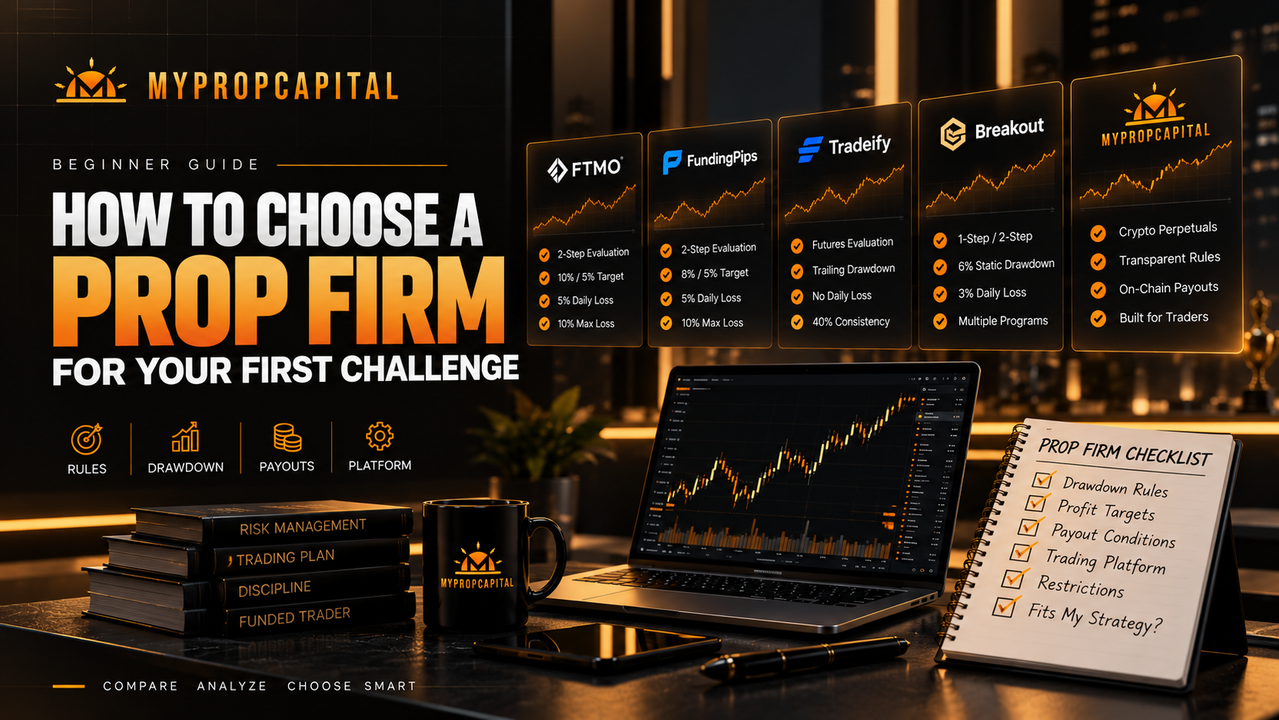
That's still a very different place to be than "trust our payout team." And it's why the questions in our guide to choosing a prop firm still matter: drawdown type, daily limits and payout conditions decide whether you get paid at all.
The bottom line
A prop firm can say anything. A contract can only do what it was written to do. Before you pay for your next challenge, ask the firm for its payout addresses. If it has them, check them. If it doesn't, you've learned something important for free.
Ready to trade somewhere you can audit? Pick an evaluation and see every rule before you pay.